Dissolution Decisions Loom for Two Small NC Towns
The takeovers of Rowland and Ronda mark the 14th and 15th time the LGC has initiated a financial takeover of a unit since 1931. It's only dissolved one unit in its history but points out that it's "ok" for local governments to pursue voluntary dissolution.

by Mackenzie Thomas, Carolina Public Press
On the heels of a financial takeover of two North Carolina towns last month, Local Government Commission (LGC) staff are exploring the possibility of dissolving each of them once and for all.
A team of LGC staff have been working with the towns of Rowland and Ronda over the past month to assess their current financial situations. Rowland has faced issues including the improper use of grant funds to help fund its current operations, while Ronda has dealt with problems including an aging water system that led to plummeting balances in its water and general funds.
“People in Ronda and Rowland deserve local governments that can pay their bills, manage taxpayer dollars responsibly and provide the services residents depend on,” State Treasurer Brad Briner said in a press release.
“Our priority is to protect taxpayers and maintain essential services while we determine whether these towns have a financially sustainable path forward. These are difficult decisions, but we owe residents a thorough and responsible review of every option.”
While staff have already obtained bank and financial records, made numerous in-person visits and coordinated with several state agencies and other local governments to address current issues and maintain operations, they are still working to collect more information that will tell them whether these towns can be saved or not, according to LGC records.
By next month’s meeting, they could have their answer.
Rowland’s Financial Situation
The LGC described eight criteria used to assess the towns’ current financial situations: population, property valuation trend, available fund balance, audit completion and filing dates, repeat problematic findings from audits, governance and others focusing on their water and sewer funds.
Among these areas, there were a few that appeared to be most problematic for Rowland, a town of just under 900 people located near the South Carolina line in southwestern Robeson County.

For example, its available fund balance had been steadily decreasing since 2022, until it finished fiscal years 2024 and 2025 in the negative, according to LGC records. Other issues included a history of late audit submissions since 2021, as well as repeated findings of overspending and the use of restricted grant funds for unapproved, operational expenses.
Its water and sewer fund has also been hemorrhaging money, operating at a negative balance for the past five years.
Members of the LGC voted to conduct further evaluation of town finances at the latest meeting, which could help inform a decision on whether to dissolve the town or not. But the consensus seems to be that things aren’t looking good.
“I didn’t really see anything positive,” one LGC commissioner noted after hearing the recent findings.
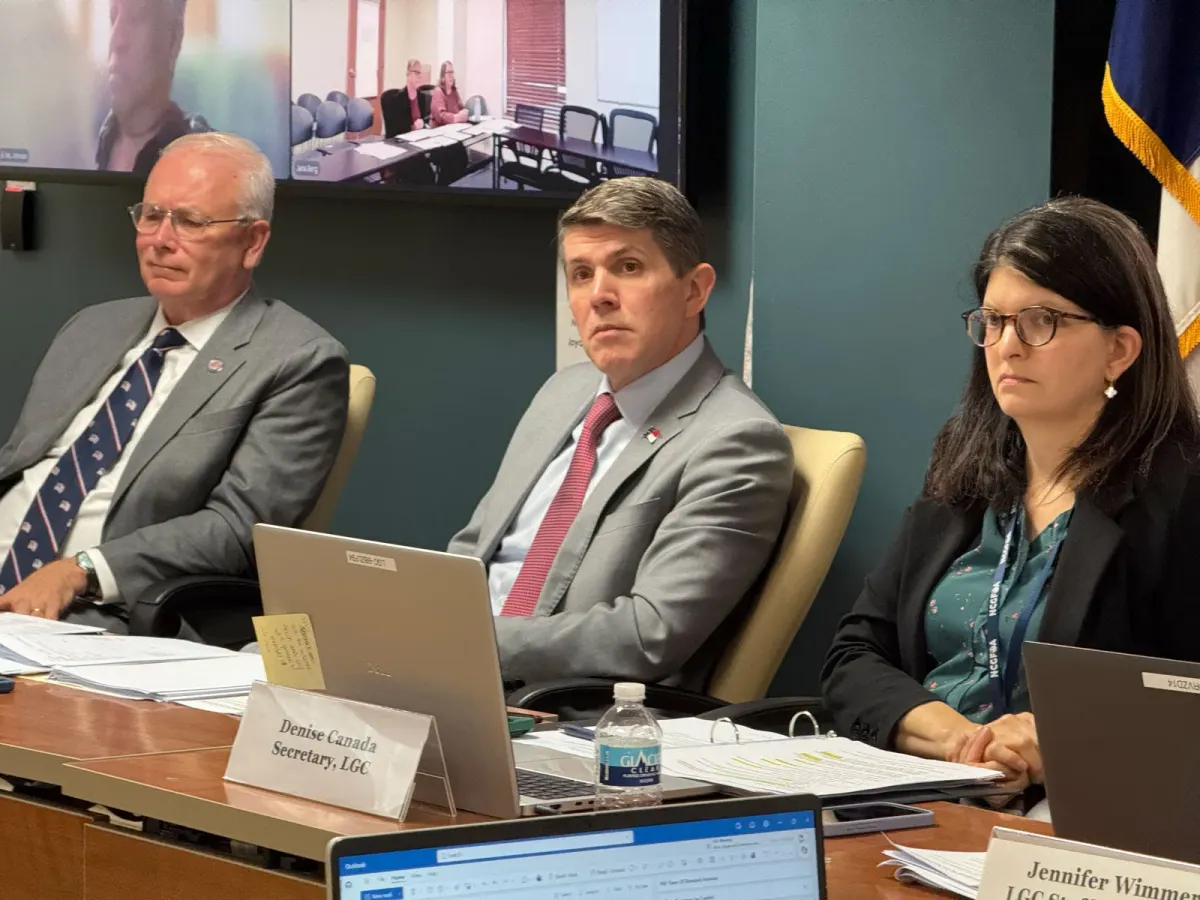
“Things are not looking good at all for the town of Rowland, and I think that would be an understatement,” LGC Secretary Denise Canada said.
“But I want our staff to have a firm handle on the town’s assets and liabilities before we can make that final recommendation.”
Ronda’s Financial Situation
Recent findings by LGC staff show that the town of Ronda, located in eastern Wilkes County with about 400 residents, hasn’t fared much better.
They found issues in a lot of the same areas as Rowland: available fund balance — though diminished, it’s not currently operating in the red like Rowland — a history of late audits, years’ worth of overspending and a negative balance in its water and sewer fund for the past four years.

Staff found other problems too. One was Ronda’s deteriorating property tax rates, which declined from 0.4 in 2013 to 0.25 in 2025.
“Property tax revenue typically accounts for a significant percentage of a city’s revenues, and a pattern of declining valuations can signal potential difficulty in generating sufficient revenue to support and maintain the city’s operations,” Canada wrote in the proposed resolution.
Another was a history of vacancies in town governance positions. While the role of mayor is currently being filled by Kevin Reece, the town has gone without an elected mayor for a while now. Between April 2025 and June 2026, the town saw three mayors resign. A “fully seated” governing board is described as “essential” to continued operations, Canada wrote.
In addition to these, State Auditor Dave Boliek conducted his own review of Ronda. In his Oct. 5 report, he listed a series of findings, including a “significant and deteriorating financial position.”
Over the course of this month, a review will be conducted for both towns that includes a financial assessments report, a report on current town services and potential options to address financial deficiencies, LGC staff said.
“This review will assess whether either town can be financially rehabilitated and brought to a state of financial stability,” they said.
A recommendation for dissolution could be presented for both towns as early as the next LGC meeting on Dec. 1. If that happens, the next step would be making a plan with local government partners to transition the towns’ assets, liabilities and other obligations, LGC staff said.
Dissolution is Not the End
The takeovers of Rowland and Ronda mark the 14th and 15th time the LGC has initiated a financial takeover of a unit since 1931, Carolina Public Press previously reported. It’s only dissolved one unit in its history, which was East Laurinburg in June 2022, LGC staff said.
CPP previously reported that 145 units across the state were on the commission’s Unit Assistance List last year, and three have received notices of warning in the past year — the highest level warning that can be issued by the LGC. While a notice of warning doesn’t necessarily mean that dissolution is imminent, it does point to significant financial concerns.
Based on the most recent fiscal year 2025 audit data, it appears 153 units are now on the list.
Noting this trend of struggling units, Canada said during the meeting that she hopes local governments know it’s “OK” to pursue voluntary dissolution.
“One thing that I’m hoping we can do through these discussions is to let other local governments that are in a financial precarious situation, probably do not have a financial future, know that it is OK to pursue voluntary dissolution,” she said.
“It’s not an inferior state of being to be unincorporated. You’ve heard me say before: 40% of the state lives in unincorporated communities.”
When asked whether the commission is seeing any other units with the same issues as Rowland or Ronda, or if they anticipate any other units facing dissolution in the future, LGC staff said: “Our staff continue to monitor local governments’ financial status and their compliance with Chapter 159.”
This article first appeared on Carolina Public Press and is republished here under a Creative Commons Attribution-NoDerivatives 4.0 International License.